
 Posted by
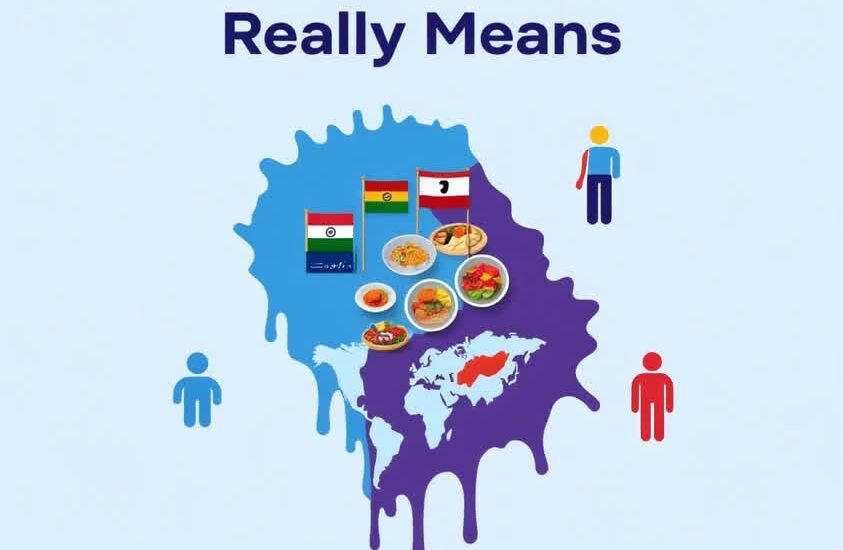
 Years ago, I remember standing in my grandmother’s kitchen, watching her fold something that looked suspiciously like a Korean dumpling into what she swore was a family recipe passed down from her Italian mother. When I asked her about it, she just shrugged and said food travels, people travel, and eventually everything ends up mixed together, whether we like it or not. That moment stuck with me longer than I expected, and it is probably the reason I keep coming back to the idea of cross-cultural contamination whenever I think about how societies actually work. Discover how cross-cultural contamination shapes identity, language, and tradition through migration, globalization, and daily cultural exchange today.
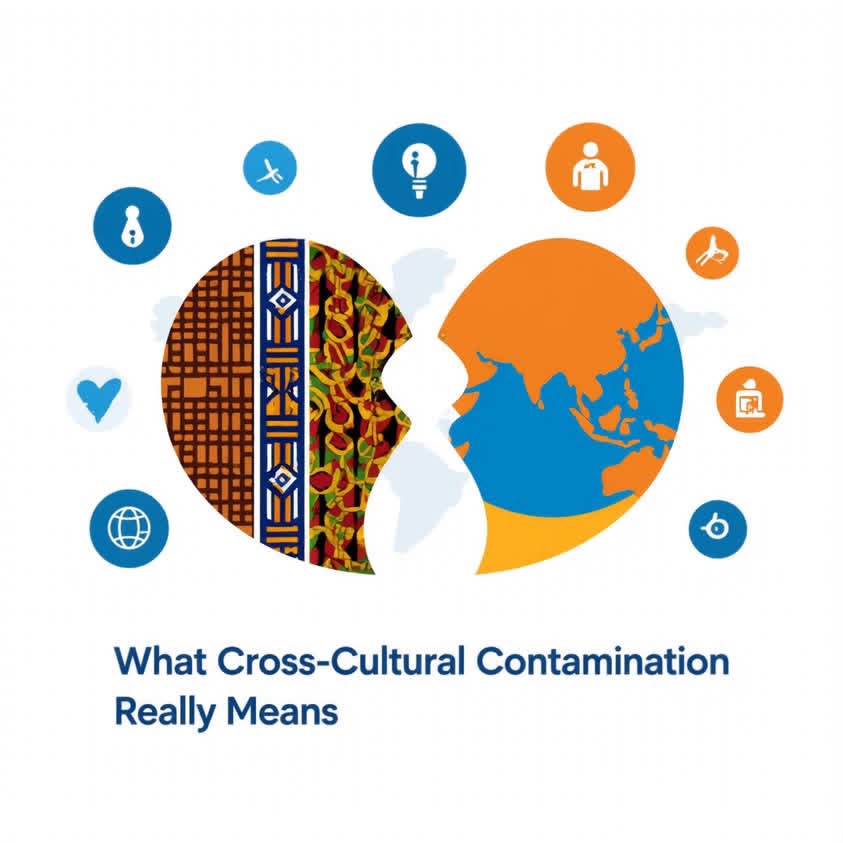
Cross-cultural contamination, as a concept in sociology, refers to the blending, borrowing, and reshaping of cultural elements when different groups come into sustained contact. It sounds almost clinical when you put it that way, does it not? But in practice, it looks like my grandmother’s kitchen. It looks like slang words that jump from one language into another and never really leave. It looks like music genres that split apart and recombine until nobody can agree on where one style ends and another begins.
I think the word contamination throws people off a bit. It carries a negative weight, like something pure has been spoiled. Sociologists who study cultural diffusion and hybridity have pointed out for decades that this framing is misleading, because cultures were never sealed containers to begin with. Every tradition we think of as ancient or untouched was, at some point, shaped by contact with outsiders. Trade routes, colonization, migration, war, and yes, tourism, have all pushed cultural exchange forward, whether the people involved wanted it or not.
Here is a question worth sitting with for a second. If nearly every cultural practice we consider authentic was actually formed through contact with other groups, what does authenticity even mean anymore? I do not have a tidy answer for that, and honestly, I am suspicious of anyone who claims they do. What I can say is that studying cultural mixing helps us understand identity formation in a much more honest way than pretending cultures exist in isolation.
Globalization obviously speeds this whole process up. Social media, in particular, acts like a pressure cooker for cultural exchange, taking what used to happen over generations and compressing it into weeks or days. A dance trend from Nigeria shows up in a teenager’s bedroom in Ohio by Tuesday. A fashion aesthetic born in Tokyo streetwear culture gets reproduced by fast fashion brands in Europe before the original creators even get proper credit. This is where cross-cultural contamination gets messier, because speed does not always mean fairness. Cultural appropriation debates often live right at this intersection, where borrowing without acknowledgment starts to feel less like exchange and more like extraction.
I try to remind myself, though, that intent and context matter enormously here. A community sharing its traditions willingly with outsiders is a different social process than a dominant group lifting symbols from a marginalized one and stripping away their meaning. Sociologists studying power dynamics in cultural diffusion tend to focus on exactly this distinction, because contamination is not inherently harmful, but it is also not automatically harmless just because it happens.
What I find genuinely fascinating is how resilient certain cultural cores remain even after heavy contact. Language is a good example. English has absorbed thousands of words from French, Latin, Hindi, Arabic, and dozens of other languages, yet somehow it still functions as a coherent system with its own grammar and rhythm. Contamination did not destroy it. It reshaped it. Maybe that is the real lesson buried in all of this. Cultures are not static museums meant to be preserved under glass. They are living systems that absorb pressure and adapt, sometimes clumsily, sometimes beautifully.
I still think about my grandmother sometimes, and how unbothered she was by the idea that her family recipe had picked up influences from somewhere else entirely. She did not see it as a loss. She saw it as evidence that her family had lived a full life, bumped into other people, and picked up a few good ideas along the way. There is something almost hopeful in that outlook, honestly.
Cross-cultural contamination, at the end of the day, is not a threat to identity so much as proof that identity was never meant to stay still. Social identity theory suggests we build our sense of self partly through group belonging, but belonging has never required purity. It only requires a connection. And connection, as messy and unpredictable as it can be, tends to be where the most interesting parts of human culture actually come from.
Reference
Hall, S. (1990). Cultural identity and diaspora. In J. Rutherford (Ed.), Identity: Community, culture, difference (pp. 222–237). Lawrence & Wishart.
Kipng’etich, L. (2024). Cultural hybridity and identity formation in globalized societies. International Journal of Humanity and Social Sciences, 2(5), 14–25. https://doi.org/10.47941/ijhss.1885
Marotta, V. (2020). Cultural hybridity. In G. Ritzer (Ed.), The Blackwell encyclopedia of sociology. Wiley-Blackwell.