
 Posted by
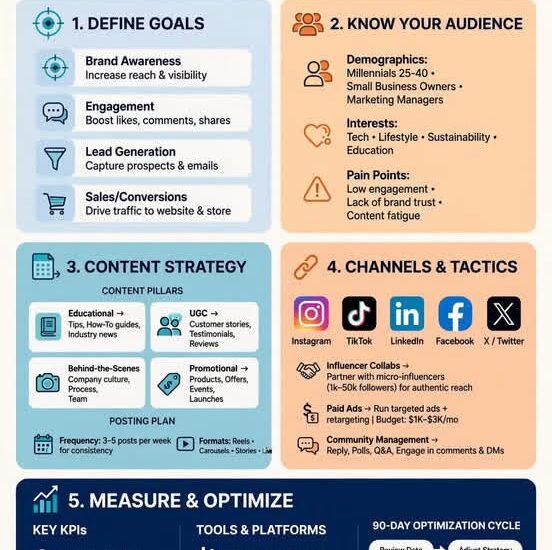
 Learn social media marketing strategy lessons from real experience: know your audience, pick the right platforms, boost engagement, and track what matters. I still remember the first time I posted on behalf of a small business and watched absolutely nothing happen. No likes, no comments, not even a pity heart from a cousin. I had spent two hours on that photo and caption, and the silence felt personal. That quiet moment taught me more about social media marketing than any course ever did, because it forced me to ask a question I had been avoiding: who exactly was I talking to?
Most beginners, and I was definitely one of them, treat social media marketing like a megaphone. You shout your offer, add a few hashtags, and hope the algorithm does the rest. It rarely does. Research has long pointed out that these platforms work as conversations rather than broadcasts, with customers talking to each other as much as they talk to brands (Kaplan & Haenlein, 2010). Once I accepted that, my whole approach to building a social media strategy started to shift.
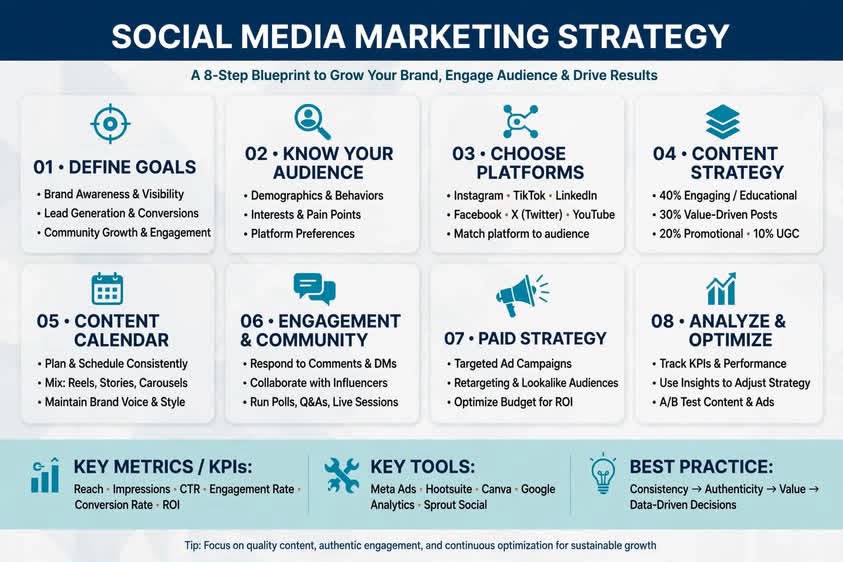
Start with your target audience, and I mean really start there. I used to guess. I would say “young professionals” and call it a day, which is about as useful as saying “people who eat food.” When I finally looked at who was actually commenting, saving, and sharing, the picture was far more specific and a little surprising. They were mostly parents juggling work, short on time, and hungry for practical tips rather than polished ads. Rewriting my content for them felt like switching from a formal speech to a chat over coffee.
Choosing the right social media platforms comes next, and this is where many people burn out. I once tried to run five accounts at the same time. By week three I was recycling the same tired post everywhere, and none of the platforms liked it, least of all me. Now I pick one or two where my audience already spends time and go deep. Depth beats presence every time, at least in my experience.
Consistency matters too, though I will admit I am not naturally a consistent person. A simple content calendar saved me. Nothing fancy, just a shared sheet where I sketch out what goes live each week and why. It keeps my social media content tied to real goals like brand awareness, website traffic, or sales, instead of whatever random idea hits me at 11 p.m. Do I still miss a day now and then? Of course. But a loose plan beats a perfect one that never gets used.
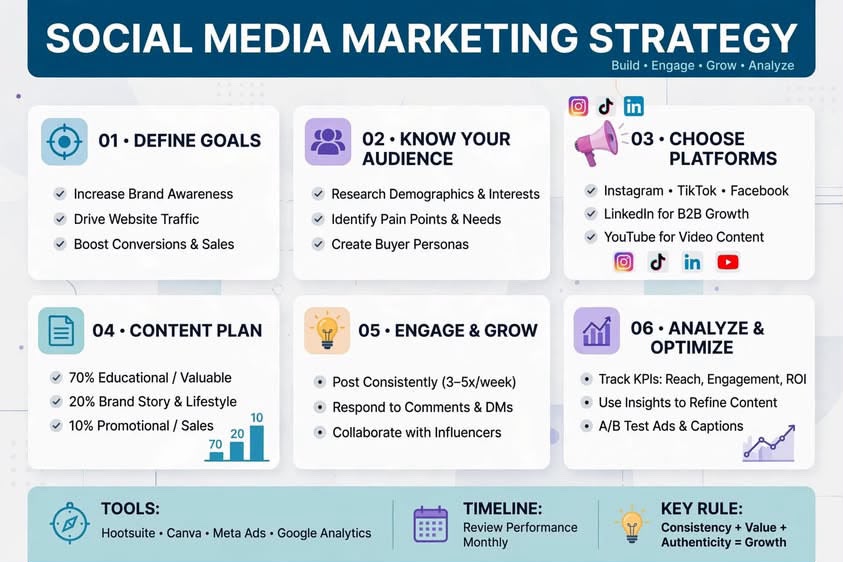
Engagement is the part people underestimate. Posting is only half the job, and the other half is showing up in the comments, answering questions, and sharing other people’s work. I remember a customer who left a tiny comment asking whether a product came in blue. I replied within the hour, and she not only bought two but tagged us in a story the following week. That single exchange did more for our online presence than a month of scheduled posts. Scholars studying the future of social media in marketing make a similar point, noting that brands increasingly succeed by building communities rather than chasing reach alone.
Then there is honesty, which sounds obvious but gets tricky once influencer marketing enters the picture. If you partner with creators, disclose it clearly. The Federal Trade Commission expects endorsements to be transparent, and audiences are quicker than ever to spot anything that feels hidden (Federal Trade Commission, 2019). I learned this when a partner post of mine felt a bit too slick, and the comments turned lukewarm almost immediately. Trust is slow to build and very quick to lose, so I protect it.
What about measuring results? This is where I used to freeze, because numbers felt like a test I had not studied for. These days I keep it simple and watch a handful of social media metrics: reach, engagement rate, clicks, and conversions. Those tell me whether people are noticing, caring, visiting, and buying. When something flops, I treat it as information rather than a verdict on my talent, which took me an embarrassingly long time to learn.
Looking back, the most useful shift was giving up the idea that social media marketing is a trick. It is a habit, a relationship, and sometimes a mildly humbling experiment. Be patient with your growth, stay curious about your audience, and keep your voice human. If you do that, the likes will eventually come, and the better news is that the conversations will come with them.
Reference
Appel, G., Grewal, L., Hadi, R., & Stephen, A. T. (2020). The future of social media in marketing. Journal of the Academy of Marketing Science, 48(1), 79–95. https://doi.org/10.1007/s11747-019-00695-1
Federal Trade Commission. (2019, November). Disclosures 101 for social media influencers. https://www.ftc.gov/business-guidance/resources/disclosures-101-social-media-influencers
Kaplan, A. M., & Haenlein, M. (2010). Users of the world, unite! The challenges and opportunities of social media. Business Horizons, 53(1), 59–68. https://doi.org/10.1016/j.bushor.2009.09.003