
 Posted by
Learn how business valuation works, from discounted cash flow to market multiples, and find out what your company is really worth before you ever sell it. Last spring my uncle Ray called me, almost out of breath, to say a buyer had offered him $400,000 for his heating and cooling company. He wanted to know whether he should take it. I asked him one simple question, and the line went quiet for a good five seconds. What is the business actually worth? After twenty-two years of crawling through attics in July, he had never once thought about business valuation.
I am no certified appraiser, but I spend a lot of time around small business owners, so I told him I would help him dig in. What I learned over the next few weeks changed how I look at every company, even the corner coffee shop. Business valuation is simply the process of estimating what a company is worth, and it matters far more often than people think. Sure, it matters when you are selling a business. It also matters when you bring in a partner, apply for a loan, plan an estate, or go through a divorce. Honestly, it is smart to know your number even if you never plan to sell.
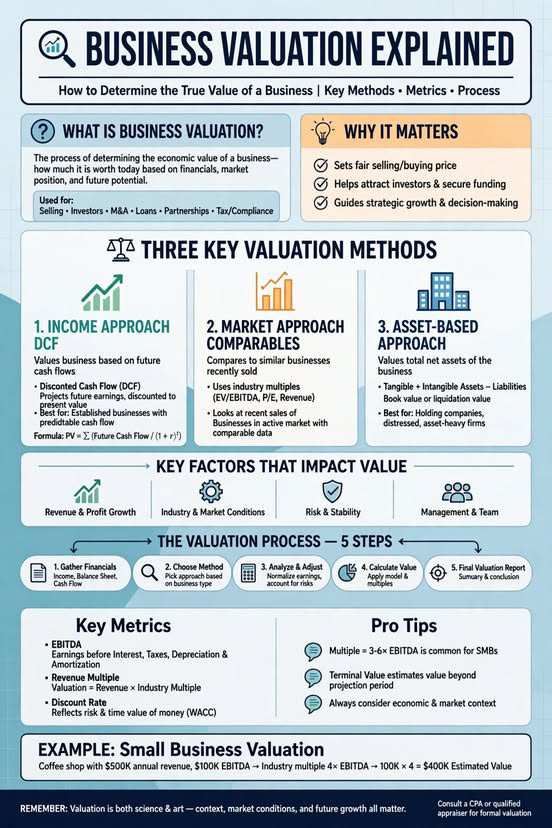
So how do you value a business? Most professionals lean on three business valuation methods, and each one tells a slightly different story. The income approach looks at what the company will earn in the future and shrinks those future dollars back to today’s value using a discount rate. You will hear this called discounted cash flow, or DCF. It sounds fancy, but the idea is easy enough: a dollar next year is worth less than a dollar in my pocket right now, and a risky dollar is worth even less. The market approach feels more like pricing a house. I look at what similar companies sold for and apply a multiple, often a multiple of EBITDA or annual revenue, to my own numbers. The asset-based approach adds up everything the company owns, subtracts what it owes, and lands on a net asset value. It works well for businesses heavy on equipment or real estate, but it can sell a service company short, since it misses things like reputation and loyal customers.
Here is where it got interesting for Ray. His company was a service business, so the asset approach alone made his shop look tiny. Then we started normalizing his earnings, which is a clunky phrase for cleaning up the books. He had been paying his wife a salary for doing very little, and he ran his personal truck through the company. Those were not real operating costs for a new owner, so we added them back. Suddenly his earnings looked a lot healthier. I remember him saying, almost in a whisper, that nobody had ever explained any of this to him. Small business valuation lives and dies on details like that.
I also stumbled on something older than both of us. The Internal Revenue Service published Revenue Ruling 59-60 back in 1959, and it still shapes how appraisers think about closely held companies. It describes fair market value as the price a willing buyer and a willing seller would agree on when neither one is forced to act, and it tells appraisers to weigh things like earning capacity, financial condition, and the history of the company (Internal Revenue Service, 1959). It also cautions against blindly averaging different methods together. That one stuck with me, because I was tempted to do exactly that.
Does all this math actually produce reliable numbers? Research suggests it can. Kaplan and Ruback (1995) compared discounted cash flow estimates with real transaction prices and found that the estimates landed reasonably close, and that valuations built on comparable company multiples performed about as well. Still, no formula is perfect. Every business valuation rests on assumptions about growth, risk, and the discount rate, and small changes in those assumptions can swing the final number by a lot. I have seen two honest appraisers end up far apart on the same company. That is not a failure. That is just the nature of the beast.
Ray hired a professional for a proper business appraisal in the end, and the final figure came in well above that first offer. He did not sell to the original buyer. A few months later he sold to a larger competitor for a price that let him retire comfortably and still help pay for his granddaughter’s tuition. Would he have landed that deal without knowing his number? I doubt it.
If you take one thing from my rambling, let it be this. Get a handle on your company value before somebody else tells you what it is. Gather three years of financial statements, figure out your true earnings, and talk to a qualified business appraiser or valuation professional. It will cost you some money and maybe a little ego, yet it might save you from leaving a fortune on the table. Whether you are thinking about selling a business next month or next decade, business valuation is a conversation worth having sooner rather than later.
Reference
U.S. Department of the Treasury, Internal Revenue Service. (1959). Revenue Ruling 59-60 (1959-1 C.B. 237).
Kaplan, S. N., & Ruback, R. S. (1995). The valuation of cash flow forecasts: An empirical analysis. The Journal of Finance, 50(4), 1059–1093. https://doi.org/10.1111/j.1540-6261.1995.tb04051.x