
 Posted by
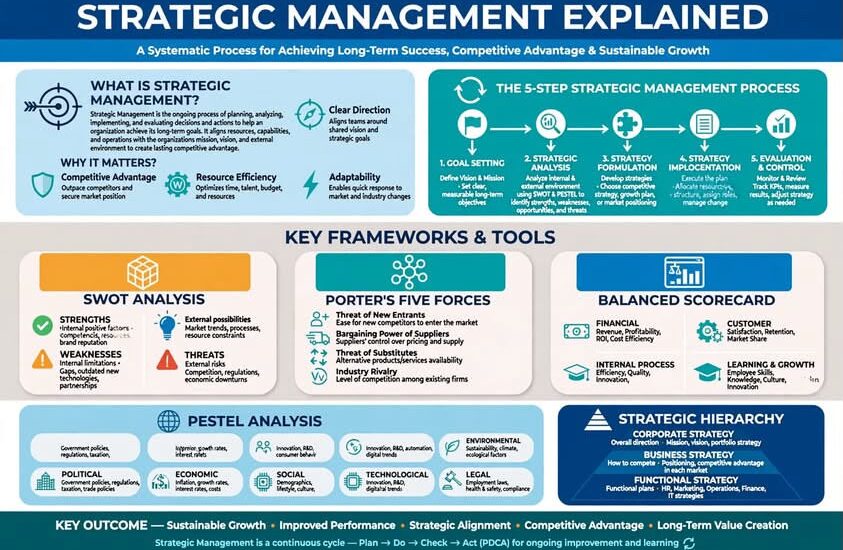
 Learn strategic management the practical waybuild a business strategy, run a SWOT analysis, gain competitive advantage, and avoid common planning mistakes. The first time I sat in a strategy meeting, I nodded along for ninety minutes without understanding a single thing. Words like “core competencies” and “market positioning” floated around the table, and I kept thinking everyone else had received a handbook I had somehow missed. Years later, after plenty of mistakes and a few wins, I can tell you that strategic management is far less mysterious than it sounds. It is simply the habit of deciding where you want to go, figuring out how to get there, and then, this is the part people skip, checking whether you are actually moving in the right direction.
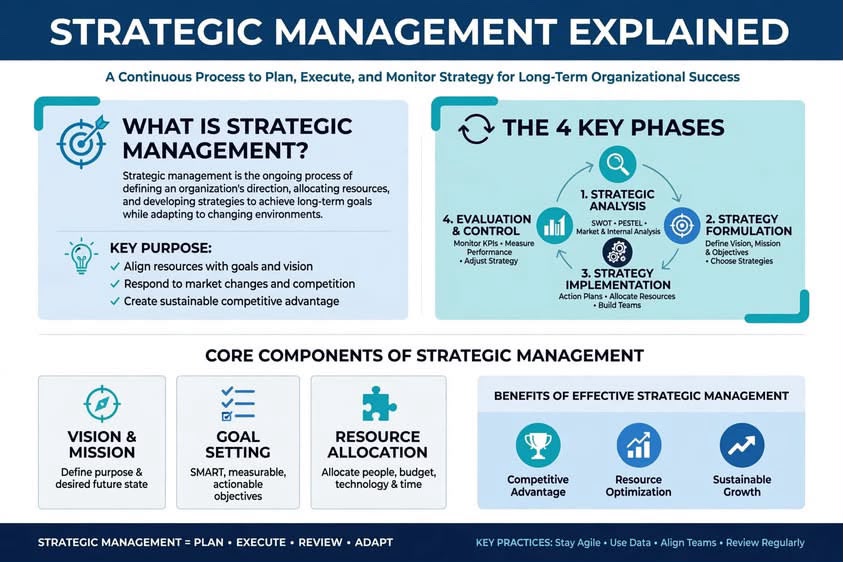
Let me back up. Strategic management is the ongoing process of setting long-term goals, analyzing your environment, choosing a business strategy, and putting it into action. Notice the word ongoing. I used to believe a strategy was something you wrote once, printed on nice paper, and tucked into a drawer. My first manager did exactly that. Every January we got a glossy plan, and by March nobody remembered a word of it. Honestly, that taught me more about what not to do than any textbook ever did.
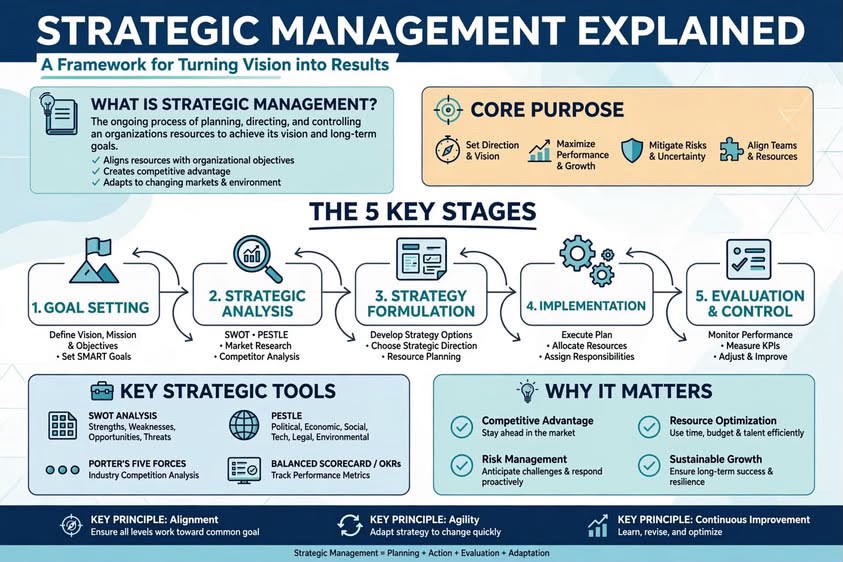
So where does good strategic planning begin? For me, it always starts with the mission and vision. I know, I know, they sound like corporate fluff. But when a small team I worked with finally wrote down why we existed and what we wanted to look like in five years, the arguments in meetings dropped by half. Suddenly we had something to measure ideas against. Does this new project move us toward the vision, or is it just shiny? That single question saved us from at least three expensive detours.
Next comes the honest look around. A SWOT analysis is the classic tool here, and yes, it can feel a bit like homework. Still, I have found that it works when you are brutally candid. Strengths and weaknesses live inside your company, while opportunities and threats come from outside. Once, my team listed “great customer service” as a strength, and then a quiet colleague pointed out that our response times had doubled over the past year. Ouch. But that moment of discomfort reshaped our whole plan, and I am grateful for it.
After that, you have to make real choices, and this is where competitive advantage enters the picture. Every strategic decision is really a tradeoff. You cannot be the cheapest, the fanciest, and the fastest all at once, no matter what the sales deck says. I watched a local bakery near my old apartment try to do exactly that. They slashed prices, added a dozen new products, and promised same-hour delivery. Within a year they were exhausted, and the quality had slipped. The bakery down the street picked one thing, outstanding sourdough, and built everything around it. Guess which one is still open?
Here is the part nobody warned me about: strategy implementation is where most plans die. A brilliant strategic management process on paper means very little if the people doing the work do not understand it. I learned this the hard way when I rolled out a new plan and assumed everyone had absorbed it from one slide presentation. They had not. Weeks later, two departments were chasing opposite priorities, and I felt rather foolish. Since then, I repeat the main goals constantly, probably to the point of annoying people, and I tie them to daily tasks so that no one has to guess.
Measurement matters too, though I will admit I resisted it for a long time. Numbers felt cold to me. But strategic goals without checkpoints are just wishes with better formatting. Now I set a few simple indicators, review them every quarter, and ask whether the strategy still fits reality. Markets shift, customers change their minds, and sometimes a competitor shows up out of nowhere. Flexibility is not a sign of a weak plan. It is a sign that someone is paying attention.
If you are wondering whether all of this applies to a small business or a solo project, it absolutely does. I have used the same basic approach to plan my own freelance work, and it brought a calm I did not expect. Instead of saying yes to every request, I now ask whether a job supports my long-term goals. Sometimes the answer is no, and I let it go without guilt.
So what is my takeaway after all these years? Strategic management is not about fancy frameworks or impressive vocabulary. It is about clarity, honest analysis, smart tradeoffs, and relentless follow-through. Start small if you must. Write a mission you actually believe in, run a candid SWOT analysis, pick one area where you can build a real competitive advantage, and check your progress regularly. You will make mistakes, and I certainly did. Just keep adjusting, keep asking questions, and keep the long game in mind. Trust me, your future self will thank you.
Reference
Barney, J. (1991). Firm resources and sustained competitive advantage. Journal of Management, 17(1), 99–120.
Hill, T., & Westbrook, R. (1997). SWOT analysis: It’s time for a product recall. Long Range Planning, 30(1), 46–52.
Hrebiniak, L. G. (2006). Obstacles to effective strategy implementation. Organizational Dynamics, 35(1), 12–31.