
 Posted by
 I still remember the email that changed my opinion on research assistantships. A finance professor I barely knew sent a two line message asking if I wanted to help clean a dataset for a paper on private equity returns. Cleaning a dataset. Not exactly the kind of thing that shows up in a recruiting brochure for an MBA program, and honestly my first reaction was mild disappointment. I had pictured something closer to strategy consulting, not spreadsheets full of missing values. But that assistantship ended up teaching me more about how research actually works than any core class did, and I want to make the case here for why MBA students should stop overlooking these roles when they think about career development and applied learning opportunities.
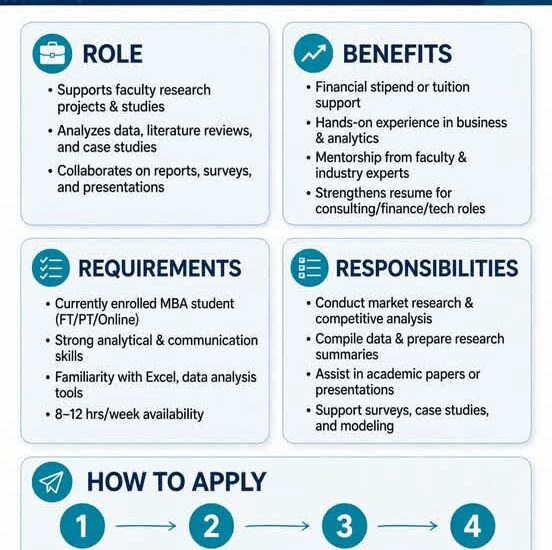
A research assistantship, for anyone unfamiliar with the term, is basically a part time position where a student supports a faculty member’s research project. Sometimes that means running regressions, sometimes it means literature reviews, sometimes it is just organizing interview transcripts so a professor does not lose their mind before a conference deadline. It is not glamorous. But is glamour really what graduate business education should be optimizing for? I do not think so, and I say that as someone who once thought the same way.
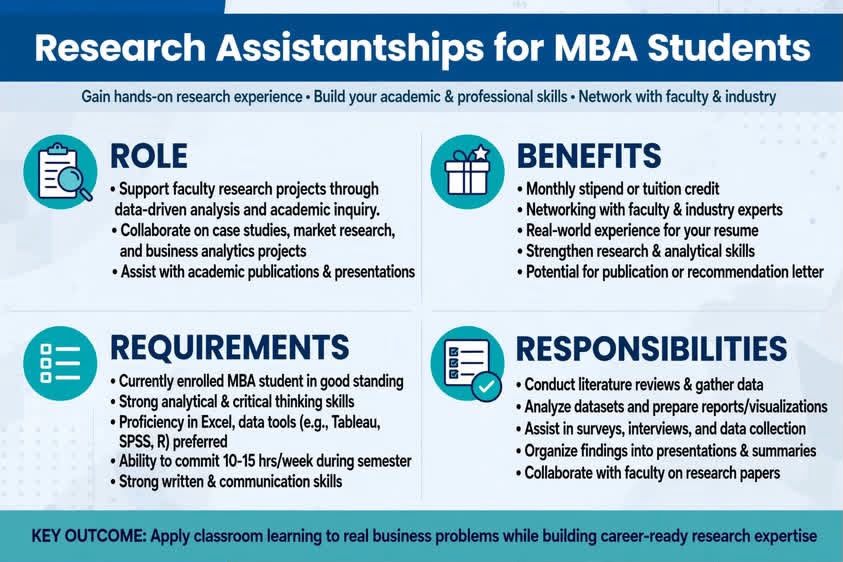
One thing that surprised me about working as a research assistant in a business school setting is how directly it connects to the quantitative skills employers keep asking about. MBA programs talk a lot about data driven decision making, yet a surprising number of students graduate without ever having built a real regression model from messy raw data. Research assistantships force that kind of hands on statistical work. You are not working with a clean textbook dataset that was designed to teach a specific concept. You are working with something closer to what you will encounter in corporate strategy or business analytics roles, full of gaps and outliers and decisions that do not have an obvious right answer.
There is also the mentorship angle, which I think gets undersold. Faculty advisors who take on MBA research assistants tend to invest real time in the relationship, partly because good assistants are hard to find and partly because academics genuinely like talking about their work to someone who is paying attention. My advisor would sit with me for an hour some weeks just talking through why a certain variable was behaving strangely in our model. Those conversations taught me how to think like a researcher, which turned out to be surprisingly close to how a good management consultant thinks. Ask why the data looks the way it does before you trust any conclusion drawn from it.
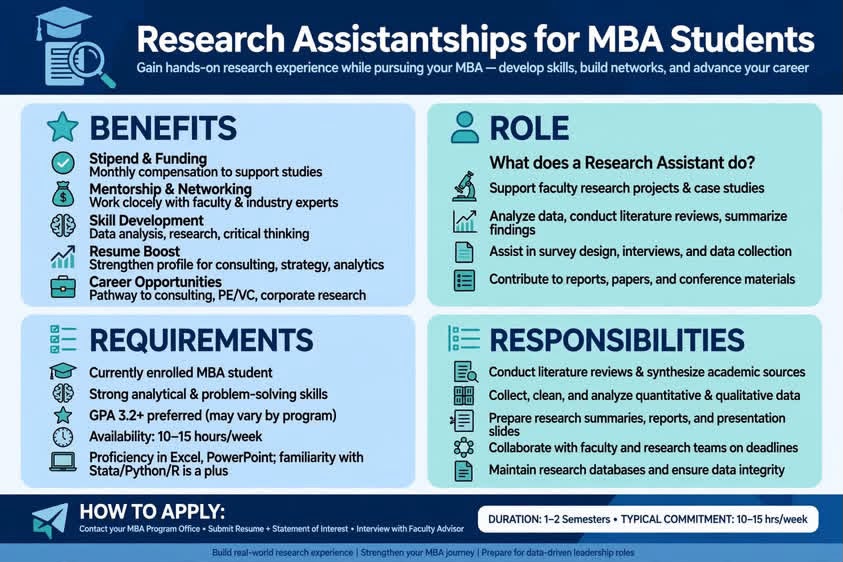
Networking is the other piece people underestimate. Business school research often crosses into industry, whether that is through case studies, surveys of practicing managers, or datasets licensed from corporate partners. As a research assistant I ended up on a call with a mid level executive at a logistics company who was providing operational data for our study. That connection later turned into an informational interview, and eventually a referral. Would that have happened if I had spent that semester only attending networking events and coffee chats? Maybe, but probably not with the same depth of context behind the conversation.
I know what some readers are thinking. The pay for a research assistantship is often modest compared to a summer internship at a bank or consulting firm, and the time commitment can conflict with an already packed MBA schedule of case competitions, recruiting, and core coursework. Those are fair points and I am not going to pretend otherwise. But framing this purely as an economic trade off misses something important about how MBA career development actually works over the long run. A strong research assistantship experience gives you a specific, defensible story for interviews. Instead of saying you are analytical, you can describe the actual model you built and the actual business question it addressed.
There is also a quieter benefit that took me a while to appreciate, which is the exposure to academic writing and publication standards. Business research follows fairly rigorous methodology, and being part of that process even in a supporting role sharpens your ability to structure an argument, defend a claim with evidence, and anticipate counterarguments. Those are exactly the skills that show up later when you are writing a business plan, defending a capstone project, or pitching a strategic recommendation to a skeptical executive team. Nobody hands you those skills in a lecture. You build them by doing the work, mistakes included.
Reference
Kitts, R. L., Koleoglou, K. J., Holland, J. E., Hutchinson, E. H., Nang, Q. G., Mehta, C. M., Tran, C. M., & Fishman, L. N. (2015). A novel service-oriented professional development program for research assistants at an academic hospital: A web-based survey. JMIR Medical Education, 1(2), e11. https://www.ncbi.nlm.nih.gov/pmc/articles/PMC5041349/
Massachusetts Institute of Technology, Sloan School of Management. (n.d.). Teaching and research assistantships. In MBA Policy Handbook. https://mbapolicyhandbook.mit.edu/academics/teaching-and-research-assistantships/
Panzik, C. J., Light, C. J., et al. (2025). Unlocking potential: Mentorship training perspectives from undergraduate peer mentors in course-based undergraduate research experiences. CBE—Life Sciences Education. https://pmc.ncbi.nlm.nih.gov/articles/PMC12369326/