
 Posted by
 I remember the first time someone explained Six Sigma to me at a previous job, and honestly? It sounded like corporate buzzword soup. Define, measure, analyze, improve, control all said in one breath like it was self-explanatory. My eyes probably glazed over. It took actually seeing the methodology applied to real problems before I understood why this particular approach has stuck around for decades across manufacturing, healthcare, and beyond. Let me walk you through what I have learned.
So what is Six Sigma, really? I have spent years watching this methodology transform everything from factory floors to hospital wards, and I want to share what I have learned about the DMAIC framework, Lean Six Sigma, and why this process improvement approach still matters so much today. The Six Sigma methodology started at Motorola back in the 1980s. It was originally built as a set of techniques to tighten up the company’s manufacturing processes and reduce product defects to an extremely minimal level.
The name itself refers to a statistical target: a process operating at true six-sigma quality produces only 3.4 defects per million opportunities. That is an almost absurdly high bar for consistency when you think about it. From Motorola, the approach spread to General Electric under Jack Welch and then across countless other industries, eventually becoming shorthand for rigorous, data-driven quality improvement generally.
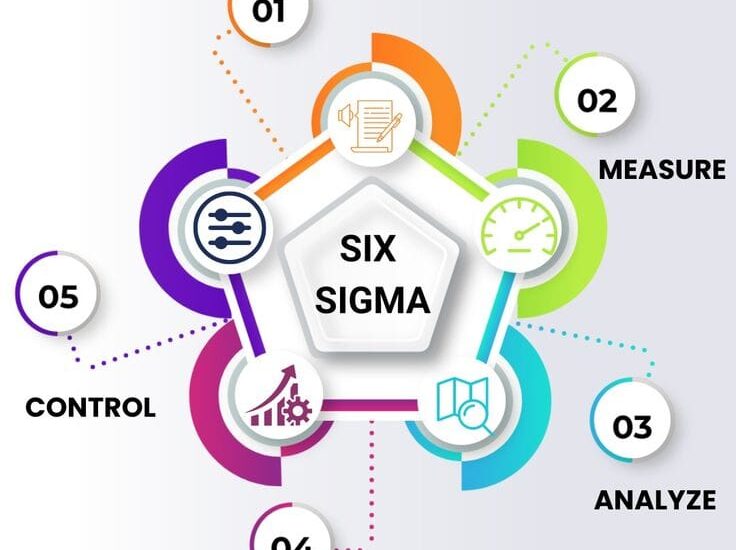
The core of Six Sigma is a five-phase framework known as DMAIC. This stands for Define, Measure, Analyze, Improve, and Control. Let me break down what each phase actually looks like in practice, because that is where the magic happens. Inthe Define phase, a team identifies the actual problem, sets goals, and figures out who the internal and external customers are along with what they actually need.
This sounds simple, but you would be surprised how often organizations skip this step and start solving the wrong problem entirely. Measure is about establishing a baseline. You are actually quantifying how the process performs right now before anyone tries to change anything. No guessing. No gut feelings. Just cold, hard data.
Analyze digs into root causes rather than surface symptoms. This is where you ask “why” five times in a row until you actually get somewhere meaningful. Improvement is where the team pilots and implements actual changes. And Control locks those improvements in with monitoring systems so the process does not quietly drift back to its old, worse-performing state a few months later.
What I appreciate about DMAIC, having watched it applied outside pure manufacturing settings, is how flexible it turns out to be. There is published research applying the exact same framework to something like hospital nursing shift-change assignments. A team used DMAIC to improve a process’s quality level from a sigma score of 0.7 all the way up to 3.3, a genuinely massive jump in consistency for something as mundane-sounding as shift handoffs. That is the kind of real-world impact that gets me excited.

The approach has also been applied in tire manufacturing to reduce material waste, in distribution centers to cut order fulfillment time nearly in half, and in plenty of service-industry contexts most people would not initially associate with a methodology born on a factory floor. Have you ever wondered why your online orders seem to arrive faster than they used to? Process improvement techniques like this are often the answer.
Lean Six Sigma, the more commonly practiced version today, blends the original defect-reduction focus with Lean manufacturing’s emphasis on eliminating waste and non-value-added steps. The two ideas complement each other beautifully. Lean asks whether a step should exist at all, while Six Sigma asks how to make the steps that do exist more consistent and reliable. Together, they create a powerful one-two punch for anyone serious about operational excellence.
If there is one criticism worth naming, it is that Six Sigma can become bureaucratic overkill when applied to problems that do not actually need this level of statistical rigor. Not every messy process requires a Black Belt certification and a formal control chart. I have seen teams spend weeks collecting data for problems that could have been solved with a simple conversation and a bit of common sense.
But for genuinely high-stakes, high-volume processes where small defect rates compound into real cost or real harm, the discipline earns its reputation. Think about pharmaceutical manufacturing, aircraft maintenance, or hospital emergency rooms. In those environments, a 99.9 percent success rate is not good enough when you are dealing with millions of opportunities for error. That is where the Six Sigma methodology truly shines.
I have come to see Six Sigma as less of a rigid set of rules and more of a mindset. It is about being honest with yourself about what is actually happening in your processes, rather than assuming everything is fine. It is about having the courage to look at data that might challenge your assumptions. And it is about committing to continuous improvement rather than settling for “good enough.”
The DMAIC framework gives you a structured way to do all of that without getting lost along the way. Whether you are running a factory, managing a hospital department, or just trying to get your team’s weekly reporting process under control, there is something valuable here.
What has your experience been with process improvement methodologies? Have you seen Six Sigma in action, or does it still sound like buzzword soup to you? I would love to hear your thoughts. And if you want to dive deeper into the financial side of all this, our earlier post on cost accounting pairs well with this topic.
References
American Society for Quality. (n.d.-a). Six Sigma tools: DMAIC, lean & other techniques. https://asq.org/quality-resources/sixsigma/tools
American Society for Quality. (n.d.-b). DMAIC
process: Define, measure, analyze, improve, control.
Employees’ preference analysis on lean six sigma program coaching attributes using a conjoint analysis approach. (2023). PMC. https://pmc.ncbi.nlm.nih.gov/articles