
 Posted by
 Real stories, practical tips, and lessons on boosting team morale and workplace collaboration. I used to roll my eyes at the word teambuilding. Honestly, who didn’t? It always conjured up images of trust falls in a hotel conference room, someone in khakis yelling about synergy, and a sad tray of bagels that nobody touched. But after spending years bouncing between different workplaces and watching what actually moves the needle on team morale, I have come around.
Good teambuilding, the kind that is not just a checkbox on an HR calendar, can genuinely change how a group of people works together. It is not magic. It is just an intentional effort applied consistently, and there is a real difference between the two.
Let me back up and tell you about the worst teambuilding exercise I ever sat through. We were split into groups and asked to build a tower out of spaghetti and marshmallows while a facilitator timed us with a stopwatch, like we were defusing a bomb. My group lost spectacularly. Our tower collapsed twice, someone got a marshmallow stuck in their hair, and by the end, nobody felt closer to anyone; we just felt tired and a little embarrassed. That experience taught me something important, though, which is that teambuilding activities only work when they actually mirror how people communicate and solve problems in real work situations, not when they are reduced to a cute icebreaker with a timer attached.
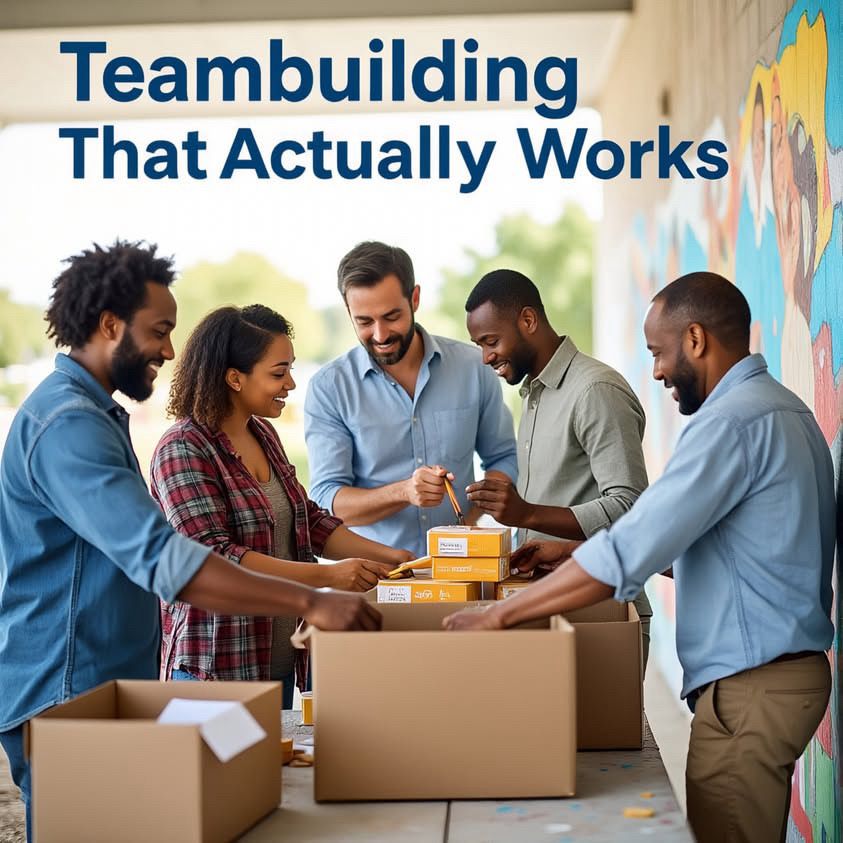
What changed my mind was a much smaller, much less polished exercise at a different job. Our manager, whom I will call the most unassuming leader I have ever worked under, asked everyone on the team to bring in one object that represented a personal challenge they had overcome. No props, no fancy facilitation guide, just six people sitting around a table sharing something true about themselves.
I brought in an old running shoe because I had trained for and finished a marathon two years after a knee injury that doctors said would keep me off pavement for good. By the end of that hour, I knew things about my coworkers that I never would have learned over months of casual small talk in the break room. Is that not strange, how thirty minutes of honest sharing can do more for collaboration and team cohesion than an entire quarter of polite Slack messages?
That is the thing about teambuilding that so many companies miss. They treat it like a one-time event rather than an ongoing investment in workplace culture. You cannot do one retreat in the mountains and expect trust and communication to hold steady for the rest of the year. Team dynamics shift constantly, new hires come in, projects create pressure, and conflict, even small conflict, needs somewhere to go. The organizations I have seen build genuinely strong, high-performing teams treat relationship building as part of the actual job, not a distraction from it. They build in regular moments, sometimes as simple as starting a meeting with a quick personal check-in, for people to actually see each other as humans rather than just names attached to deliverables.
There is also a practical side to all this that I think gets overlooked. Strong teambuilding directly affects employee engagement and retention, and frankly, it affects the bottom line. When people trust their teammates, they ask for help sooner instead of quietly struggling. They give honest feedback instead of nodding along in meetings and complaining later.
Conflict resolution becomes faster because there is already a foundation of goodwill to draw on. I have worked on teams where psychological safety was almost nonexistent, and I have worked on teams where it was strong, and the difference in output, creativity, and frankly happiness was night and day. Productivity is not just about better processes or fancier software; it is about whether people feel safe enough to actually contribute their best thinking.
So what actually works, if not spaghetti towers and trust falls? In my experience, the best teambuilding activities tend to be the ones that ask people to collaborate on something with real stakes, even small ones. A volunteer project, a cooking class where everyone has to coordinate timing, and a hike where conversation naturally meanders without an agenda attached to it.
The goal is shared experience, not performance. I also think leaders underestimate how much teambuilding can happen in the regular flow of work itself, through how meetings are run, how credit gets shared, and how mistakes get handled. You do not always need an off-site to build a team. Sometimes you just need a manager willing to admit they were wrong in front of everyone.
Reference
Centers for Disease Control and Prevention, National Institute for Occupational Safety and Health. (2024, May 31). About the Total Worker Health approach. https://www.cdc.gov/niosh/twh/about/index.html
Edmondson, A. C. (1999). Psychological safety and learning behavior in work teams. Administrative Science Quarterly, 44(2), 350–383. https://doi.org/10.2307/2666999
Klein, C., DiazGranados, D., Salas, E., Le, H., Burke, C. S., Lyons, R., & Goodwin, G. F. (2009). Does team building work? Small Group Research, 40(2), 181–222. https://doi.org/10.1177/1046496408328821