
 Posted by
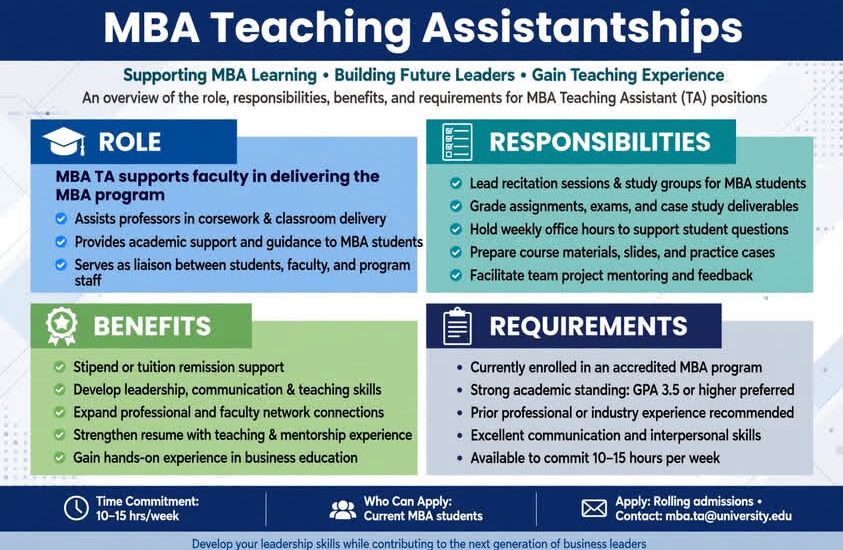
 MBA teaching assistantships build real leadership, communication, and mentoring skills before graduation. I did not apply for a teaching assistantship in my first year of business school because I wanted a line on my resume. I applied because a professor cornered me after a case discussion on organizational behavior and said, bluntly, that I explained things better than she did. That was probably an exaggeration, but it stuck with me, and a few weeks later I found myself grading spreadsheets and prepping slide decks for a course I had taken the previous semester. Looking back now, that decision shaped my entire MBA experience more than any internship did, and I think a lot of prospective students underestimate what an MBA teaching assistantship actually offers.
Here is the thing about business school. Everyone talks about networking events, case competitions, and recruiting timelines, and honestly those things matter. But teaching assistantships for MBA students rarely get the spotlight, even though they quietly build some of the most transferable leadership skills you can pick up on campus. Why does nobody talk about this more? I suspect it is because TA work sounds administrative on paper, all grading and office hours. Yet the actual experience is anything but administrative once you are in the middle of it.
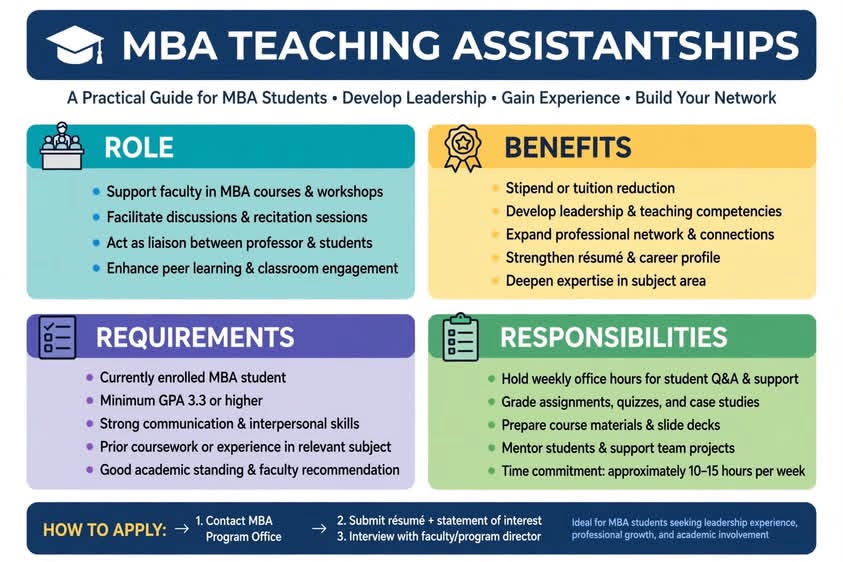
Think about what a graduate assistantship really asks of you. You are standing in front of your peers, some of whom are older than you or have run companies larger than anything you have managed, and you are expected to explain a regression model or a negotiation framework in a way that clicks. That is public speaking under pressure, and it is also a crash course in translating complexity into something usable, which happens to be exactly what managers do every single day. I remember bombing my first review session because I overprepared the content and underprepared for questions. A student asked me why the discount rate mattered so much in a valuation model and I froze for a solid five seconds. Humbling, to put it mildly. But that moment taught me more about thinking on my feet than any leadership seminar I sat through.
There is also a mentoring dimension to MBA teaching assistantships that does not get enough credit. When you hold office hours, you are not just answering homework questions. You are watching classmates work through frustration, sometimes genuine anxiety about whether they belong in the program at all. Guiding someone through that, patiently and without making them feel small, is a soft skill recruiters claim to value constantly, though I am not sure they always know how to test for it in an interview.
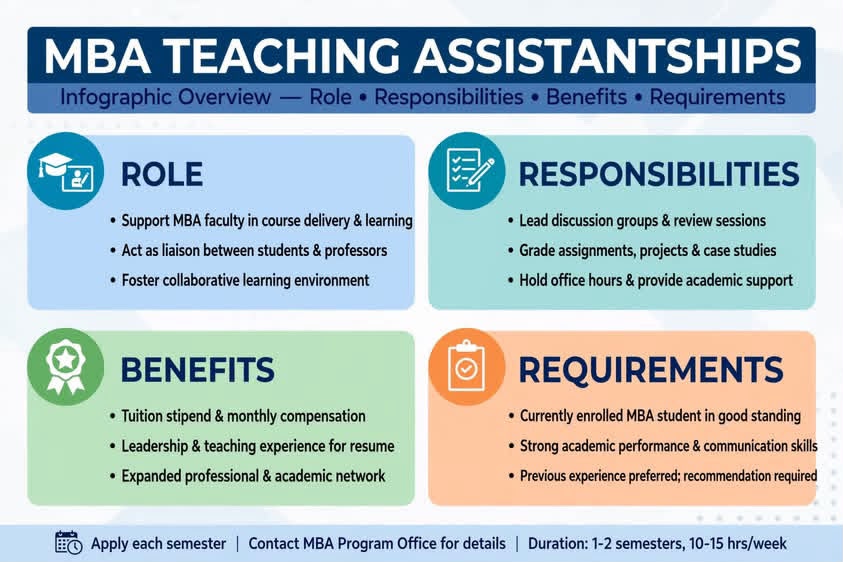
Financially, assistantships matter too, and I would be doing this topic a disservice if I skipped past that. Many MBA programs offer a stipend or partial tuition waiver in exchange for TA work, and for students managing tuition alongside living expenses, that support is not trivial. It will not fund a lavish lifestyle, let us be honest, but it eases the math a little, and it lets you build your resume without taking on a second unpaid commitment on top of coursework and recruiting.
Then there is the relationship with faculty, which I think is the most underrated part of the whole arrangement. Working closely with a professor on curriculum, grading rubrics, or even research exposes you to how academic thinking translates into practical frameworks. I ended up co-authoring a short case study with the professor I TAed for, something that never would have happened if I had just been a student sitting in the back row. That connection also turned into one of my strongest recommendation letters when I was applying for a competitive summer internship. Would that have happened otherwise? Maybe, but I doubt it would have been as strong.
Does a teaching assistantship look impressive to recruiters the way a summer internship at a top consulting firm does? Probably not on a resume skim. But in interviews, when you can describe a specific moment managing a classroom of frustrated finance students the week before midterms, that story lands differently than another generic bullet point about teamwork. Employers are not just hiring people who can follow instructions. They want people who can teach, coach, and lead under ambiguity, and an MBA teaching assistantship is basically a rehearsal space for exactly that.
I will not pretend the workload is light. Balancing TA responsibilities with your own coursework, recruiting, and whatever club leadership you have signed up for is genuinely a lot, and there were weeks I questioned whether I had bitten off more than I could chew. But if you are weighing whether to pursue a graduate assistantship during your MBA, I would encourage you to think past the stipend and the resume line. Think about the version of yourself who has to explain something difficult to a room full of skeptical, busy, occasionally impatient adults, and comes out the other side better at it. That skill does not expire when you graduate. It shows up in every meeting you run for the rest of your career, which, when I really sit with it, might be the whole point.
Reference
Cavazos, J. G., & Nixon, N. (2024). What makes equity-focused professional development effective? Insights from mathematics graduate teaching assistants. Education Sciences, 16(3), 430. https://doi.org/10.3390/educsci16030430
Hardré, P. L., & Kollmann, S. (2022). Teacher identities of graduate teaching assistants: How we (de)legitimise GTAs’ role identities. Teaching in Higher Education. Advance online publication. https://doi.org/10.1080/13562517.2022.2109015
Gardner, G. E., & Jones, M. G. (2019). Biology graduate teaching assistants as novice educators: Are there similarities in teaching ability and practice beliefs between teaching assistants and K–12 teachers? Biochemistry and Molecular Biology Education, 47(1), 32–42. https://doi.org/10.1002/bmb.21196