
 Posted by
 I spent my first year after business school working for a startup that was struggling to grow. We had a great product, a passionate team, and a growing list of customers. But we had no clear plan for scaling. We were throwing spaghetti at the wall, hoping something would stick. I remember sitting in a strategy meeting, staring at a whiteboard, and realizing I had all the tools I needed to solve this problem. I just had not applied them yet.
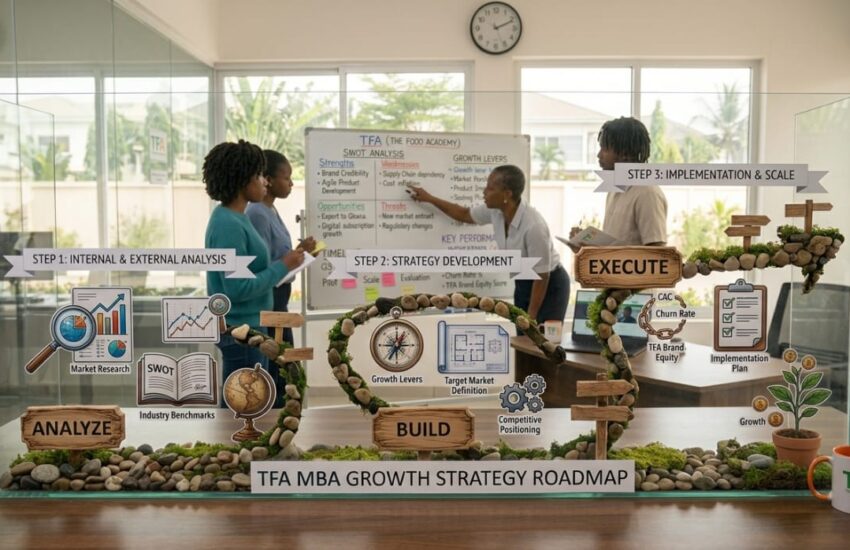
An MBA equips you with frameworks, analytical skills, and a strategic mindset that you can apply directly to building a growth strategy. The first step is to define your growth objectives. What does growth mean for your business? It could be increasing revenue, expanding market share, entering new markets, or launching new products. These goals should be specific, measurable, achievable, relevant, and time-bound (SMART). Growth without clear direction is just activity. Strategy without clarity is noise.
The next step is to understand your market and customers. Conduct market research to identify opportunities, threats, and trends. Analyze your competition to understand their strengths and weaknesses. Dive deep into customer data to understand who they are, what they need, and why they buy from you. This is where the analytical skills from your MBA shine. Use frameworks like SWOT, PESTLE, and Porter’s Five Forces to structure your analysis.
Once you have a clear understanding of your market, you need to develop a value proposition that differentiates you from competitors. Your value proposition should answer the question: Why should customers choose you over anyone else? This is the foundation of your growth strategy. It defines what you stand for and why you matter.
With your value proposition defined, you can select your growth levers. These are the specific channels and tactics you will use to acquire and retain customers. Common growth levers include marketing channels like content marketing, paid advertising, social media, and email. They can also include product improvements, pricing strategies, distribution partnerships, and customer retention programs. The key is to focus on a few high-impact levers rather than trying to do everything. Test your assumptions and be data-driven in your approach.

An MBA teaches you to prioritize. A popular framework for evaluating growth initiatives is the ICE framework: Impact, Confidence, and Ease. This tool helps you prioritize ideas by scoring them on three criteria: the potential impact, how confident you are in achieving the impact, and how easy the initiative is to implement. A growth strategy should be iterative, continuously learning and adapting based on results.
A growth strategy also needs a clear execution plan. This includes defining key performance indicators, setting milestones, and assigning responsibility. A growth strategy is not just a document. It is a living plan that guides daily decisions. By combining your MBA skills with a customer-centric mindset and a data-driven approach, you can build a growth strategy that drives real, sustainable results.
There is so much more to learn about leveraging your MBA skills to drive business growth. Our website is filled with articles on strategy, marketing, and leadership. Head over and explore, because the best strategies are the ones you build with purpose.
References
MBA.com. (2026, February 9). *5 skill development strategies to consider for career growth*.
NumberAnalytics. (2025, April 11). *MBA tips: Build and develop your career now*.
MatchToCollege. (2026, July 13). *MBA career growth: Strategies for post-grad success*.
Harvard Business School Online. (2026, April 15). * Building a Growth Strategy with Your MBA Skills
Business.com. (2011, November 19). *How to write a business growth plan*.